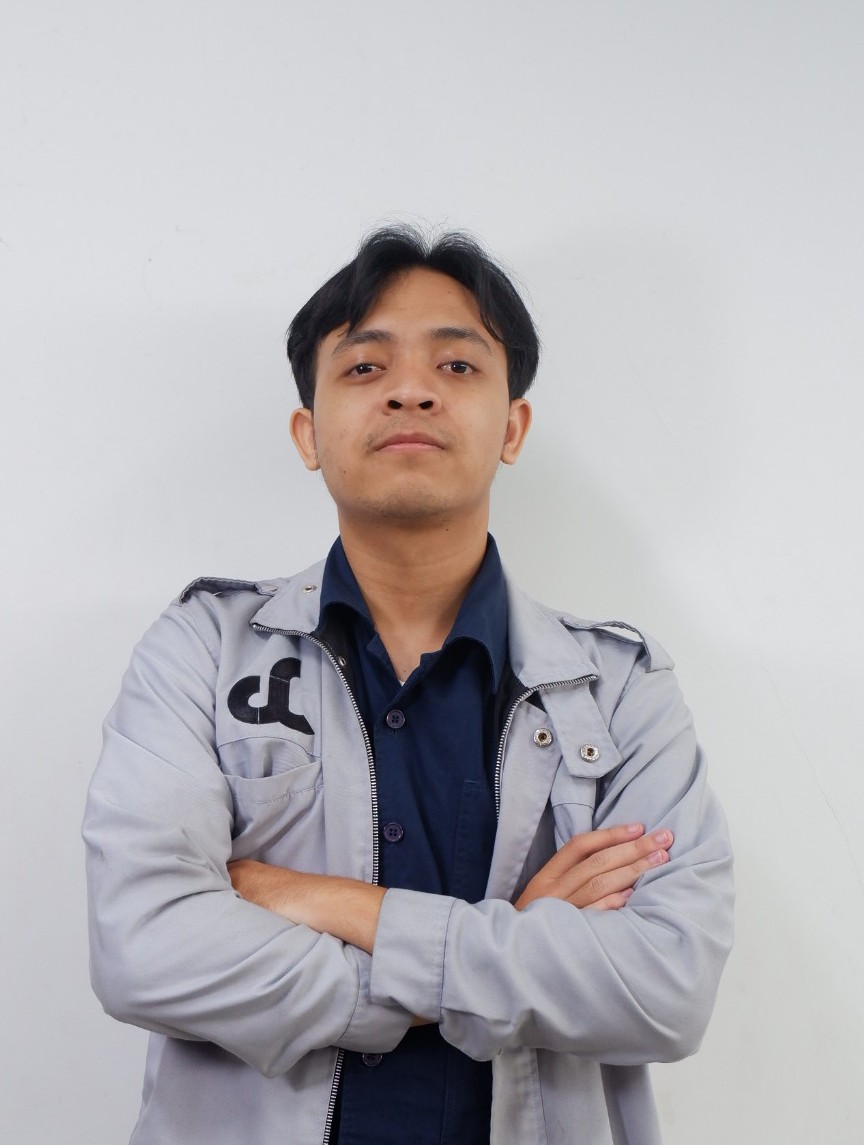
Umar Zaki
Gunawan.
I am an Engineering Physics student who builds production software, designs FPGA processor architectures, and conducts supercomputer simulations.> Bridging the physical laws of silicon with clean systems code and interactive digital laboratories.
Not just another frontend developer.
An engineer who speaks physics.
Most software engineers treat computer hardware as a black box. As an Engineering Physics student at ITB, I have spent the last four years opening that box—studying the quantum mechanics of silicon, the thermodynamics of cooling systems, and the numerical algorithms that drive scientific supercomputers.
The Physics Foundation
Chose Engineering Physics to understand how technology works from first principles—from Schrödinger's wave equation and thermodynamics to Maxwell's electromagnetism.
When you hire Umar Zaki Gunawan, you get three professionals in one:
Interactive Skills Arena.
> Zero-Gravity Floating Badges.
Instead of static progress bars, explore my engineering stack as a living zero-gravity physics arena. Move your mouse to scatter badges, click and drag to fling them across space, and select any badge to inspect live telemetry.
Python
Primary language for scientific computing, data analytics, automated HPC simulation scripts, and IoT telemetry processing.
Experience & Education.
A track record of rigorous execution.
From maintaining a 3.85 GPA in Engineering Physics to supervising 120+ students in C programming laboratories and leading student technology organizations.
Experience & Education.
A track record of rigorous execution.
From maintaining a 3.85 GPA in Engineering Physics to supervising 120+ students in C programming laboratories and leading student technology organizations.
Undergraduate Student — B.S. in Engineering Physics
Head Teaching Assistant & Lab Instructor (C Programming)
Undergraduate Research Assistant (Computational Physics Group)
Lead Software & IoT Engineer
Vice President of Technology & Workshop Coordinator
Incoming R&D Software & Semiconductor Intern
Featured Systems & Simulations.
> Interactive Folder Archives.
Indoor Air Quality IoT Dashboard & Analytics Engine
An end-to-end IoT platform deploying ESP32 microcontroller arrays with BME680, MQ-135, and PMS5003 sensors. Features real-time MQTT data ingestion, server-side Kalman filtering for noise reduction, and a high-performance dashboard displaying CO2, VOCs, particulate matter, and thermodynamic drift.
Commercial indoor air quality monitors suffer from high baseline drift and lack open API access for HVAC integration. In laboratory environments, raw particulate and VOC sensor data is plagued by high-frequency electronic noise and humidity cross-sensitivity.
Designed an embedded firmware array utilizing dual-stage Kalman filtering on an ESP32 dual-core MCU, broadcasting telemetry over TLS-secured MQTT. Built a reactive Next.js frontend with WebSockets that visualizes multi-sensor correlations and calculates real-time Air Quality Index (AQI) indices using EPA algorithms.
Research & Physics.
> Published Papers & Simulations.
The Engineering Blog.
> First-principles breakdowns & hardware tutorials.
Writing is the ultimate test of understanding. Here I dissect complex topics in semiconductor physics, low-level systems programming, and high-performance computing into clear, actionable guides.
Why Engineering Physics is the Ultimate Foundation for Modern Software Engineering
From transistors and semiconductor physics to memory hierarchies and distributed systems: why understanding the physical world makes you a 10x better systems programmer.
Demystifying Kalman Filters: How to Implement Dual-Stage Sensor Fusion on ESP32 in C++
A step-by-step mathematical breakdown and practical C++ implementation of Kalman filtering to eliminate baseline drift and noise in inexpensive IoT gas sensors.
A Programmer's Guide to Density Functional Theory (DFT) & Quantum ESPRESSO
How computational physicists simulate new semiconductor materials on supercomputers without ever touching a physical beaker or cleanroom.
Building Interactive Physics Simulations in the Browser with Next.js and React Three Fiber
Why interactive 3D WebGL visualizations are replacing static textbook diagrams in engineering education, and how to optimize 60 FPS shaders.
Let's build something
meaningful.
Whether you are recruiting for **Summer 2026 R&D internships**, exploring scientific computing collaborations, or just want to discuss semiconductor physics and systems code—my inbox is open.
Currently looking for **Summer 2026 R&D Internships** in software engineering, embedded systems, semiconductor EDA, or computational simulation.